Sorry to Bother You

Watch Trailer
Year:
2018
Runtime:
112 Min.
Director:
Boots Riley
Genre:
IMDB Rating:
6.8

Cast:

LaKeith StanfieldLaKeith StanfieldCassius Green
Tessa ThompsonTessa ThompsonDetroit
Jermaine FowlerJermaine FowlerSalvador
Omari HardwickOmari HardwickMr. _______
Terry CrewsTerry CrewsSergio
Kate BerlantKate BerlantDiana DeBauchery
sorry

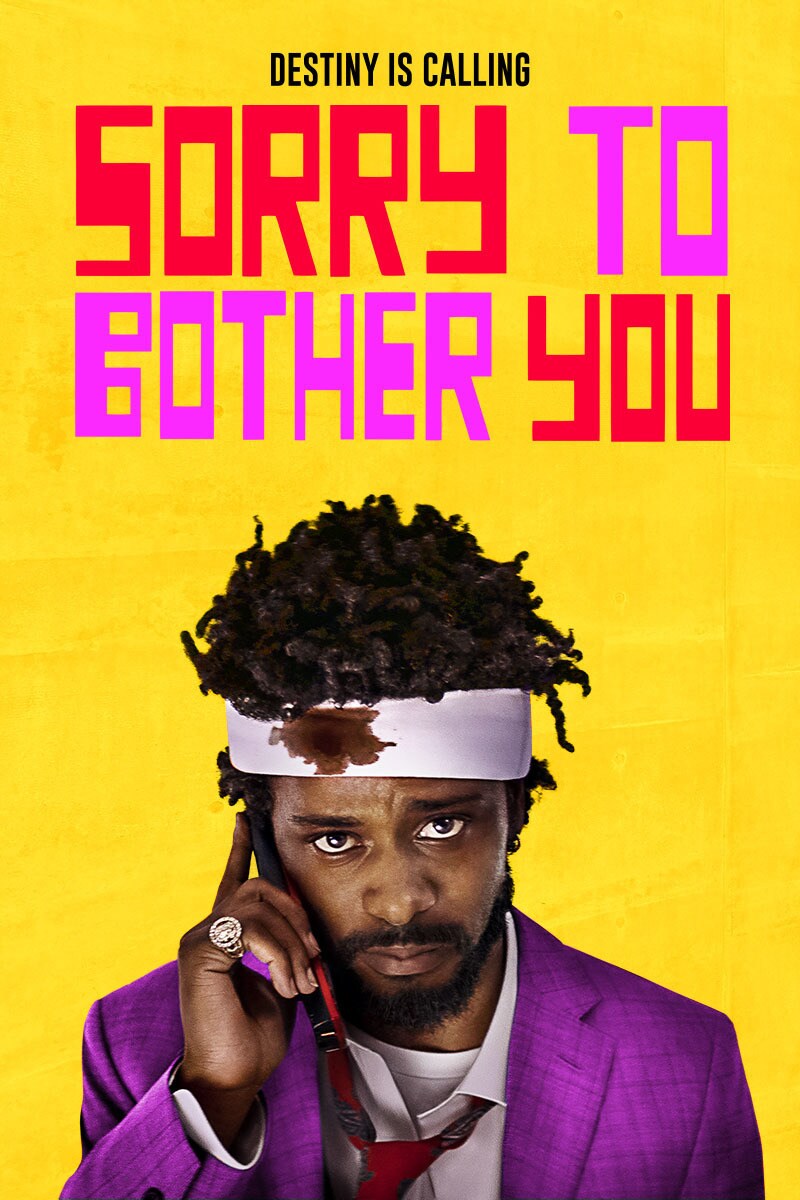
Sorry to Bother You is a 2018 American science fiction black comedy film written and directed by musician Boots Riley in his directorial debut. It stars LaKeith StanfieldTessa ThompsonJermaine FowlerOmari HardwickTerry CrewsPatton OswaltDavid CrossDanny GloverSteven Yeun, and Armie Hammer. The film follows a young African-American telemarketer who adopts a “white voice” to succeed at his job, after which he is swept into a corporate conspiracy and must choose between chasing profit or joining his activist friends who are attempting to unionize.

Principal photography began in June 2017 in Oakland, CaliforniaSorry to Bother You premiered at the 2018 Sundance Film Festival on January 20 and was theatrically released in the United States by Annapurna Pictures on July 6, 2018. Focus Features and Universal Pictures handled international distribution.[3] The film received praise for its cast, story, and soundtrack, as well as Riley’s writing and direction. It was a commercial success, grossing $18.3 million against a budget of $3.2 million.[4][5]

source: wiki

Review: Sorry to Bother You (2018)

Musician and activist Boots Riley makes an unforgettable directorial debut with **Sorry to Bother You**, a cinematic molotov cocktail that defies easy categorization. Part corporate satire, part dystopian science fiction, and entirely unhinged, the film is a fearless attack on modern capitalism and the commodification of identity.

The Plot

In an alternate, near-future Oakland, Cassius “Cash” Green (LaKeith Stanfield) is a struggling young man living in his uncle’s garage. Desperate for financial stability, he lands a low-paying job at a telemarketing firm called RegalView. After failing miserably at first, a veteran co-worker (Danny Glover) gives him a golden tip: use your “white voice” to close deals. Striking a bizarre, nasal tone of blithe privilege (voiced by David Cross), Cash becomes an overnight sensation, rapidly climbing the corporate ladder to become an elite “Power Caller.” However, as he ascends to the luxurious penthouse suite, he is forced to choose between supporting his striking, unionizing co-workers—including his radical artist girlfriend, Detroit (Tessa Thompson)—and a grotesque, highly profitable corporate conspiracy orchestrated by an eccentric tech billionaire (Armie Hammer).

Themes: Code-Switching and Corporate Slideware

The film’s most immediate theme is the concept of code-switching—the psychological cost of altering one’s speech, behavior, and appearance to fit into dominant, white-dominated power structures. Riley expands this idea into a broader critique of late-stage capitalism. It exposes how corporations co-opt and monetize dissent, transforming radical art and genuine protest into viral memes and marketing tools. The movie suggests that individual upward mobility often requires the systematic betrayal of one’s community, leading to complete personal alienation.

Performances and Direction

LaKeith Stanfield is brilliant as Cash, anchoring the film’s sanity even as the world around him devolves into madness. He perfectly conveys the quiet, hangdog exhaustion of poverty and the subsequent, hollow intoxication of corporate success.

Tessa Thompson shines as Detroit, the artistic conscience of the film, wearing statement earrings that change daily to broadcast political messages. **Armie Hammer** is terrifyingly charismatic as the amoral, cocaine-fueled CEO Steve Lift, embodying the dangerous absurdity of tech-bro messiahs.

Boots Riley’s direction is fiercely energetic and unapologetically original. He injects the film with a kinetic, surrealist visual vocabulary. For instance, whenever Cash makes a telemarketing call, his entire desk literally crashes through the ceiling and into the living rooms of his unsuspecting targets.

Cinematography and Visual Madness

The cinematography by Doug Emmett and production design by Jason Kisvarday create a vibrant, hyper-stylized universe. The aesthetics are deeply textured—contrasting the drab, concrete reality of the call center basement with the sterile, sleek, and neon-lit spaces of the corporate elite. The movie functions as a sensory assault, utilizing bold color blocks, jarring typography, and a pulsating score to keep the viewer in a constant state of mild disorientation.

Personal Resonance

Watching this film feels like riding a roller coaster that suddenly jumps off the tracks in the final act. It evokes a profound sense of shock. What resonated most was Riley’s absolute refusal to pull punches. Just when you think you understand the boundaries of this satire, the narrative takes a legendary, wildly bizarre left turn that forces you to confront the logical extremes of human exploitation. It makes you feel uncomfortable, complicit, and completely thrilled by its sheer audacity.

Verdict

Sorry to Bother You is an explosion of pure, unbridled creativity. It is messy, chaotic, and occasionally overstuffed with ideas, but its bite is razor-sharp and its political anger is entirely justified.

Who should watch:

Fans of absurdist satire like Network, dark sci-fi comedies like Brazil, or anyone looking for a unique, thought-provoking film that breaks every storytelling rule in the book.

Final thought:

A wildly unpredictable ride that challenges you to think about what you are willing to surrender just to survive the system.

Sorry to Bother You Ending Explained

⚠️ Major spoilers ahead! ⚠️

The film takes a sharp, surreal turn into body horror in the third act. When Cash reaches the highest tier of the company as a “Power Caller,” he is invited to a wild party at the mansion of eccentric billionaire CEO Steve Lift.

Looking for a bathroom, Cash accidentally opens the wrong door and discovers a group of terrifying, giant half-human, half-horse hybrids (called Equisapiens) crying out for help.

Steve Lift catches Cash and casually explains his master plan: WorryFree is genetically modifying its workers into horse-hybrids to make them stronger, more efficient, and more profitable laborers. Lift offers Cash $100 million to become an Equisapien for five years to act as a spy and “labor leader” to keep the other horse-men compliant.

Cash refuses, steals a tape of the horse-humans, and exposes the company on national television. Instead of destroying the corporation, the stock market skyrockets because investors love the idea of hyper-efficient labor.

At the very end of the movie, Cash turns into an Equisapien anyway—realizing that a white powder Lift had forced him to snort earlier was the mutation serum. The film ends with Cash leading a group of enraged Equisapiens as they violently break down Steve Lift’s front door to launch a literal workers’ revolution.

Frequently Asked Questions About:
"Sorry to Bother You"

The Equisapiens are the half-human, half-horse creatures discovered by Cash in the final act of the film. Created by the tech company WorryFree, they are the logical, terrifying extreme of corporate exploitation.

The CEO, Steve Lift, genetically engineered them to be stronger, more compliant, and more efficient workers to maximize corporate profit. Metaphorically, they represent the absolute dehumanization of the working class under late-stage capitalism, where human beings are stripped of their humanity and viewed strictly as livestock for labor.

While LaKeith Stanfield plays Cash on screen, his distinct, hyper-nasal “white voice” was dubbed over in post-production by comedian and actor David Cross (best known for Arrested Development). Similarly, the “white voice” of Cash’s co-worker, Mr. Blank, was voiced by Patton Oswalt. Director Boots Riley chose to use literal dubbing to emphasize that the voice was an artificial, unnatural performance forced upon Black workers to make white consumers feel safe.

WorryFree is a dystopian mega-corporation in the movie that offers people a solution to their financial struggles: in exchange for signing a lifetime labor contract, the company provides “free” housing, food, and employment. In reality, it is a legally sanctioned, heavily marketed form of modern slave labor. The company parodies corporate well-being culture, showing how people are driven by economic desperation to give up their basic human rights for a false sense of stability.

Detroit (Tessa Thompson) uses her large, custom-made structural earrings as wearable political art. They change in almost every scene to broadcast radical, anti-capitalist, and anti-colonial messages. Some of the most notable phrases visible on her earrings include:

  • “Kill Kill Kill” and “Murder Murder Murder”
  • “Tell Homeland Security” and “We Are Bombing Yourself”
  • “Bury the Rag” and “Deep in the Slime” (lines from a Bob Dylan song about systemic injustice)

The ending features a major twist: after exposing WorryFree’s horse-human experiments on national television, Cash is horrified to find that the public and the stock market actually embrace the mutation as a financial breakthrough. Realizing the system cannot be fixed by journalism alone, Cash reunites with his activist friends and turns into an Equisapien himself due to a snort of cocaine Lift secretly gave him earlier.

In the final scene, Cash leads a literal, physical revolt of horse-humans against Steve Lift. The ending argues that true change cannot happen within the rules of a corrupt system; it requires radical solidarity and direct, aggressive collective action.

Last updated: July, 2026
– Film details and cast information checked.
Leave the first comment