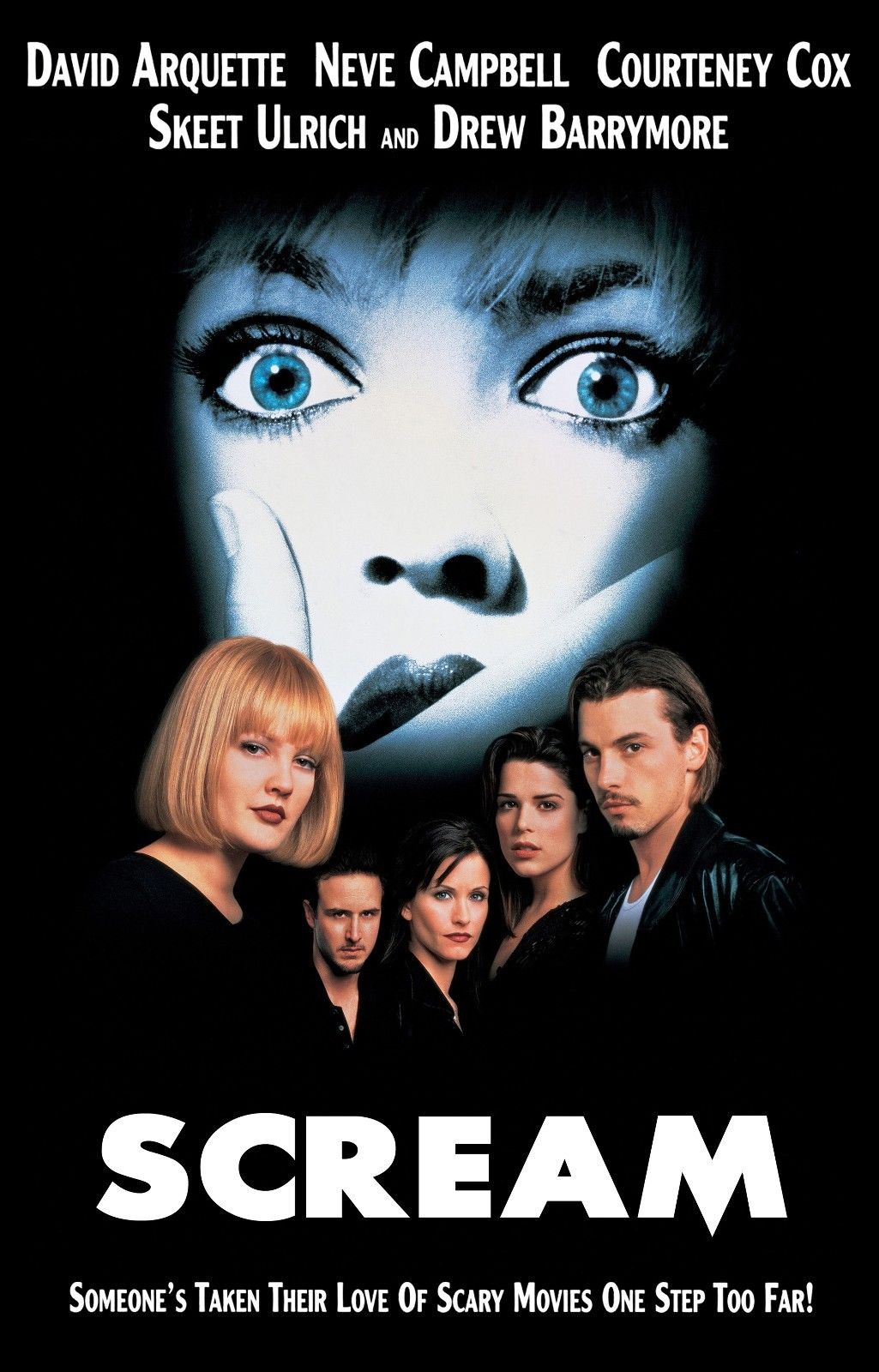
Scream is a 1996 American slasher film written by Kevin Williamson and directed by Wes Craven. The film stars Neve Campbell, Courteney Cox, Drew Barrymore, and David Arquette. Released on December 20, 1996, Scream follows the character of Sidney Prescott (Campbell), a high school student in the fictional town of Woodsboro, California, who becomes the target of a mysterious killer known as Ghostface. Other main characters include Sidney’s best friend Tatum Riley (Rose McGowan), Sidney’s boyfriend Billy Loomis (Skeet Ulrich), Billy’s best friend Stu Macher (Matthew Lillard), film geek Randy Meeks (Jamie Kennedy), deputy sheriff Dewey Riley (Arquette), and news reporter Gale Weathers (Cox). The film combined comedy and “whodunit” mystery with the violence of the slasher genre to satirize the cliché of the horror genre popularized in films such as Halloween and Friday the 13th. The film was considered unique at the time of its release for featuring characters who were aware of real world horror films and openly discussed the cliché that Scream attempted to subvert.
Based partly on the real-life case of the Gainesville Ripper, Scream was inspired by Williamson’s passion for horror films, especially Halloween (1978). The script, originally titled Scary Movie, was bought by Dimension Films and was retitled by the Weinstein Brothers just before filming was complete. The production faced censorship issues with the Motion Picture Association of America and obstacles from locals while filming on location. The film went on to financial and critical acclaim, earning $173 million worldwide, and became the highest-grossing slasher film in the US in unadjusted dollars. It received several awards and award nominations. The soundtrack by Marco Beltrami was also acclaimed, and was cited as “[one] of the most intriguing horror scores composed in years.”[3] It has since earned “cult status.”[4] Scream marked a change in the genre as it cast already-established and successful actors, which was considered to have helped it find a wider audience, including a significant female viewership.
Scream was credited with revitalizing the horror genre in the 1990s, which was considered to be almost dead following an influx of direct-to-video titles and numerous sequels to established horror franchises of the 1970s and 1980s. These sequels drew decreasing financial and critical success, as they exploited clichés upon which films in the genre had become reliant. Scream‘s success spawned a series of sequels, though only Scream 2, released in 1997, achieved a level of commercial and critical success equal to the original film. In the years following the release of Scream, the film was accused of inspiring and even inducing violent crimes and murders.
source: https://en.wikipedia.org/wiki/Scream
Review: Scream (1996)
When director Wes Craven and screenwriter Kevin Williamson unleashed Scream in 1996, they didn’t just revitalize a dying subgenre—they completely dismantled it. By injecting sharp, self-aware irony into a traditional slasher formula, the film created a blueprint for modern horror that remains a masterclass in meta-storytelling.
The Plot
The sleepy town of Woodsboro is shaken by the brutal murder of two high school students. The killer, hidden behind a ghostly white mask and a black robe, targets Sidney Prescott (Neve Campbell), a teenager still grieving the brutal murder of her mother a year prior. As the body count rises, Sidney and her friends realize the killer is playing by a specific set of rules—the rules of horror movies. With the help of a cynical film geek, a bumbling deputy, and an opportunistic reporter, Sidney must survive a real-life horror film where anyone could be the suspect, and anyone could be the next victim.
Themes: The Weaponization of Pop Culture
Scream explores the desensitization of youth culture in the late 20th century. The characters don’t just watch scary movies; they use them to navigate their own reality. Williamson’s script brilliantly tackles the media panic of the 90s regarding “movie violence,” turning it on its head by showing killers who are motivated not by cinema, but by a twisted desire for fame and notoriety. It is a film about the loss of innocence in an era where tragedy is instantly converted into entertainment.
Performances and Direction
Neve Campbell creates one of the most resilient and iconic “Final Girls” in cinema history. Sidney is not a helpless victim; she is resourceful, skeptical, and fiercely proactive. Campbell grounds the film’s heightened reality with genuine trauma and grit.
The supporting cast is legendary. Courteney Cox is brilliantly ruthless as Gale Weathers, David Arquette brings a lovable innocence to Dewey, and Matthew Lillard delivers a delightfully unhinged, manic performance that has achieved legendary status among horror fans.
Wes Craven, already a horror maestro thanks to A Nightmare on Elm Street, proves he is the perfect director to deconstruct his own genre. He balances the laugh-out-loud comedy with moments of genuine, visceral terror, ensuring the movie never becomes a pure parody.
Cinematography and Tension
Mark Irwin’s cinematography embraces the glossy, clean look of 90s suburbia, making the sudden bursts of violence feel even more intrusive. The opening sequence featuring Drew Barrymore is a technical masterpiece of escalating tension. Craven uses long tracking shots and tight close-ups to create a sense of constant surveillance, making the audience feel as paranoid as the characters on screen.
Personal Resonance
What resonates most about Scream is how smart it feels. It treats the audience with respect, acknowledging that we know the tropes just as well as the characters do. The film evokes a thrilling sense of participation; you aren’t just watching a horror movie, you are playing a game with the director. The opening sequence remains one of the most stressful and effective ten minutes in cinema history, perfectly setting the stakes and proving that no one is safe.
Verdict
Scream is a flawless cinematic tightrope walk. It is simultaneously a terrifying slasher film, a hilarious satire, and a sharp piece of cultural commentary that defined a generation.
Who should watch:
Horror aficionados who appreciate clever meta-commentary, fans of 90s pop culture, and anyone looking for a whodunit mystery with teeth.
Final thought:
A genre-defining masterpiece that changed the rules of horror by showing that the characters had read the rulebook too.