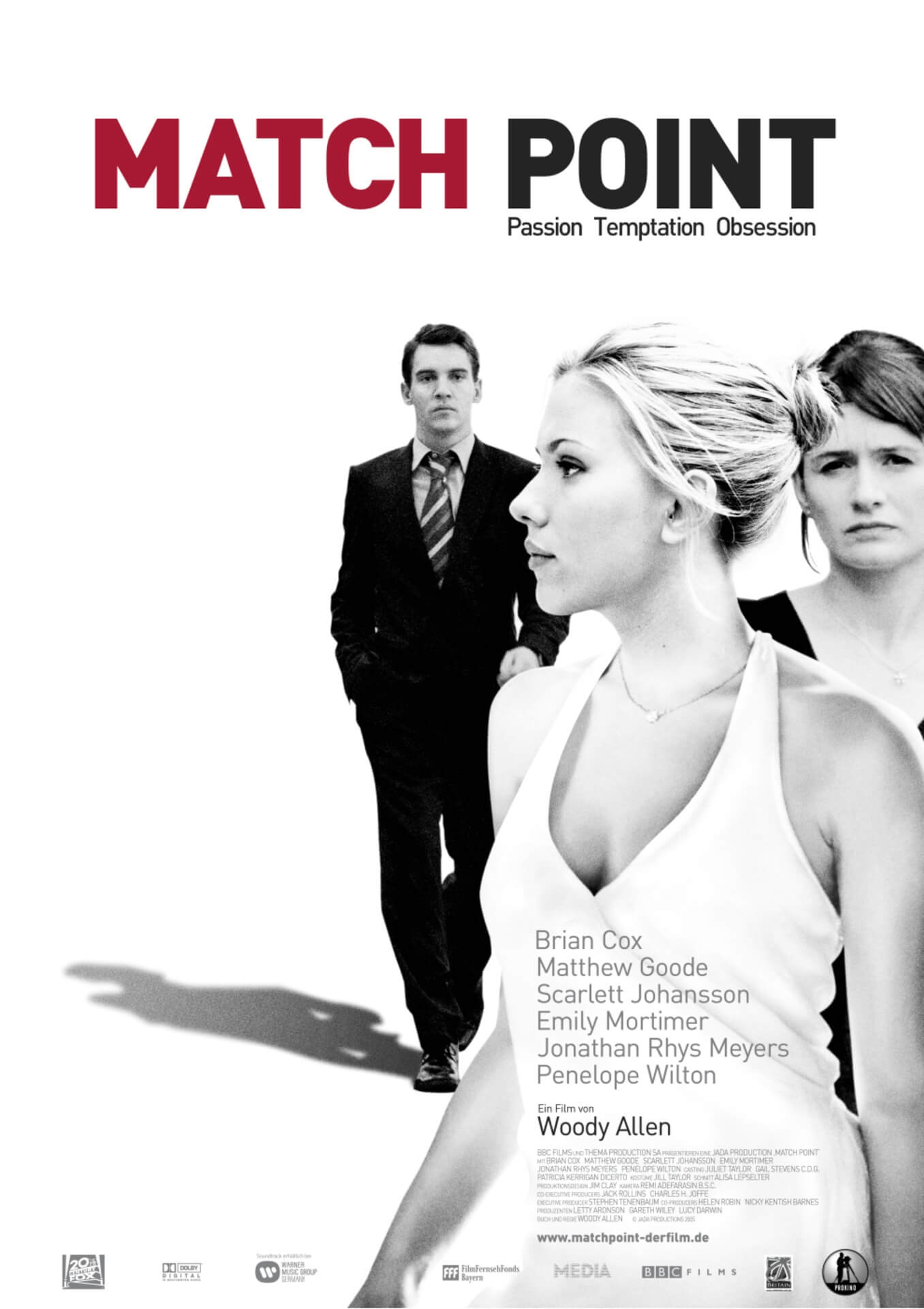
With Match Point, writer-director Woody Allen left behind his familiar New York neuroses and stepped into the rainy, affluent streets of London to deliver his most cynical and tightly wound psychological thriller since Crimes and Misdemeanors. It is a cold, calculated exploration of ambition, lust, and the terrifying role that blind luck plays in human morality.
The Plot
Chris Wilton (Jonathan Rhys Meyers) is a charming, working-class Irish tennis professional who secures a job at an exclusive London club. He quickly ingratiates himself with Tom Hewett (Matthew Goode), a wealthy pupil from a high-society family. Chris begins dating Tom’s sweet, wealthy sister, Chloe (Emily Mortimer), putting him on the fast track to executive corporate wealth and luxury. However, his upward mobility is threatened when he meets Nola Rice (Scarlett Johansson), an alluring, struggling American actress who happens to be Tom’s fiancée. An intense, obsessive affair ignites between Chris and Nola, trapping Chris in a dangerous double life where he must choose between the secure financial empire he has clawed his way into and the volatile, consuming passion that threatens to burn it all down.
Themes: Luck, Class, and Guillotine Morality
The film operates heavily on a philosophical premise: life is determined by random luck rather than divine justice. It opens with the image of a tennis ball hitting the net, posing the question of whether it will fall forward to win the point or backward to lose it. Allen uses this sports metaphor to dissect the upper-crust British class system, showing how easily wealth can buy comfort and innocence. The core theme is the complete lack of cosmic retribution; the movie suggests that the universe is entirely indifferent to human sin, and that getting away with a crime is simply a matter of which way the ball bounces.
Performances and Direction
Jonathan Rhys Meyers is exceptional as Chris, playing him with a desperate, calculating hunger. He perfectly balances the mask of a polite, grateful son-in-law with the dark, frantic energy of an social climber who will do anything to avoid going back to poverty.
Scarlett Johansson serves as the film’s electric center. She infuses Nola with a raw, tragic sensuality and a growing hysteria that makes her feel genuinely dangerous to Chris’s constructed life. Emily Mortimer provides a necessary, tragic contrast as Chloe, portraying her with an innocent, naive devotion that highlights just how predatory Chris’s world truly is.
Woody Allen’s direction is patient, sharp, and stripped of his usual comedic whimsy. He trades his traditional jazz soundtrack for dramatic, soaring Italian opera tracks, transforming a domestic affair into a grand, operatic tragedy.
Cinematography and Atmosphere
Remi Adefarasin’s cinematography captures London with a glossy, aristocratic chill. The visuals smoothly transition from the sunlit, expansive country estates of the Hewett family to the claustrophobic, rain-slicked modern apartments where Chris and Nola meet in secret. The editing maintains a slow, steady tension, building a sense of inescapable dread as Chris’s lies begin to unravel.
Personal Resonance
What resonated most about this film is its absolute lack of comfort. It evokes a profound sense of anxiety. Watching Chris navigate his lies makes you feel the tightening of a noose, yet the ultimate horror comes from the film’s moral vacuum. It makes you feel deeply uncomfortable to realize that you are rooting for a man to get away with terrible things just to watch the mechanics of his luck play out. The final act leaves you with a cold, lingering dread about the lack of justice in the world.
Verdict
Match Point is a brilliant, uncompromising thriller. It is a sharp, modern noir that stands as one of the best and most cynical entries in Woody Allen’s late-career filmography.
- Who should watch: Fans of classic literary adaptations like Crime and Punishment, lovers of high-stakes psychological dramas, and anyone who appreciates a thriller that refuses to give the audience a neat moral resolution.
- Final thought: A chilling reminder that in the grand game of life, innocence matters far less than where the ball happens to land.